

By André Christof
The recent floods that also left large parts of the Kruger National Park under water, caused great damage. All who suffered losses in the process, are in our thoughts.
Regular visitors to the Kruger, Katie and André of Two-V Productions (see their YouTube channel and Facebook page at https://web.facebook.com/OpVlerke) witnessed the power of the floodwater in amazement while recalling previous visits. André shares an excerpt describing such a visit with us. It is from his Op Vlerke series. Herewith Op vlerke: North of the Krapkuil Dam to the river forests of Shingwedzi by André Christof.
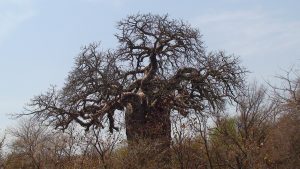
Beyond Olifantsbad Pan, on the way to Shingwedzi Rest Camp, there is an area that is only lightly forested with low vegetation and here and there a large tree (mostly the scrub mopani that becomes just a few meters high). From here, one can look out far and wide. In many spots the veld opens up inland.
Many of the trees with their multiple trunks are bare, stunted, and do not yet have new leaves on them, in contrast to the green sprouts amidst the autumn colours of the rest and the dry pale brown grass, waving, tall in places and sparse on the rocky ground.
We watch small herds of zebras standing a long way off in the veld, their tails swishing. Every now and then one lifts a front leg high under its body, or one shakes its neck so that its mane waves wildly to and fro. At times, when the flies are bothering one too much, a zebra turns its head in irritation to look at its hindquarters, then stomps furiously on the ground with a hindleg.
A mare bows her head to scratch her mouth with a hindleg. The next moment she shakes her head up and down a few times, then her upper lip pulls back so that only teeth are visible, and then she lets out a loud “pfffff”.
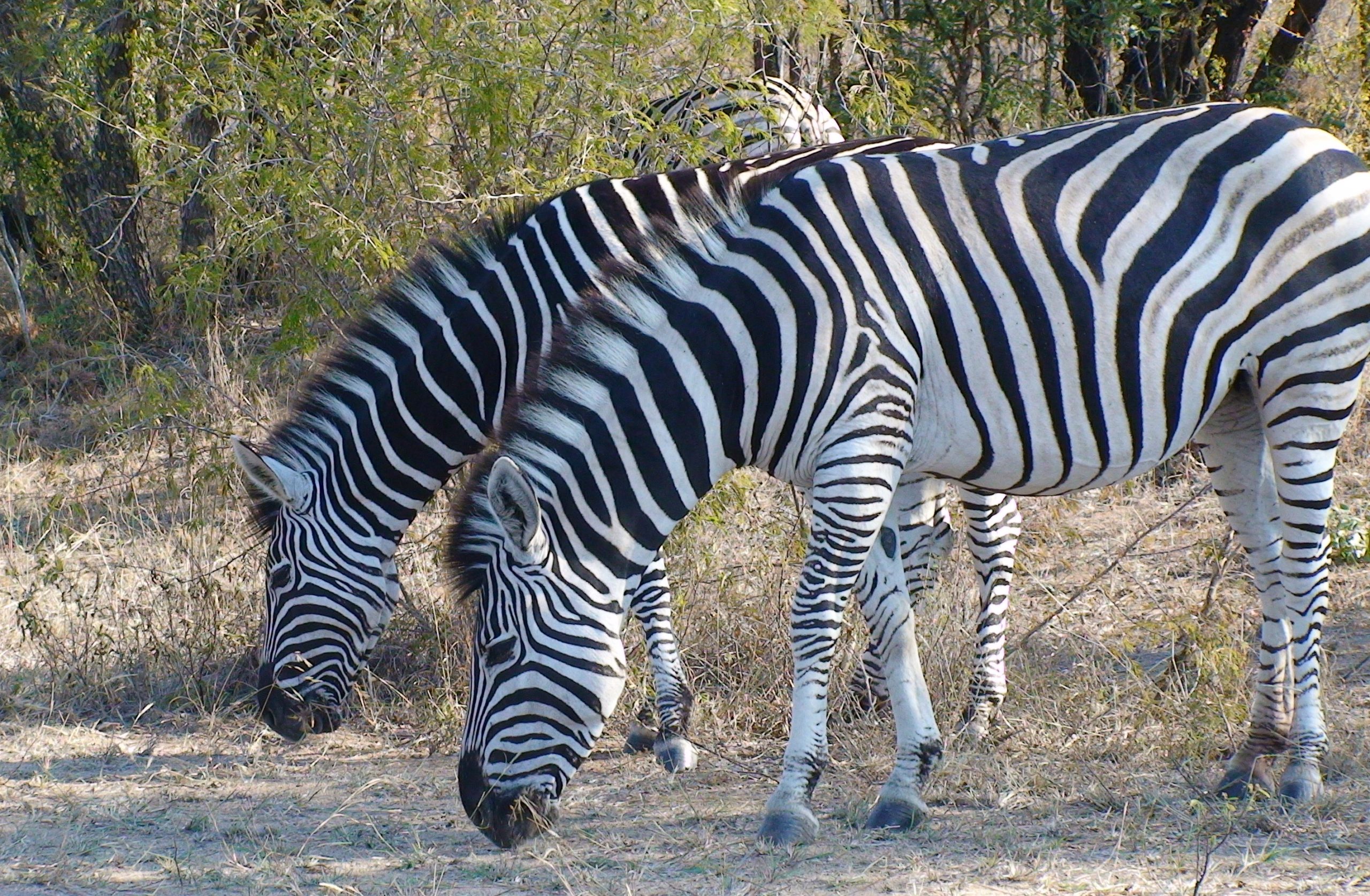
Two zebras are walking a distance away, step by step, calmly side by side, lowering their heads low to the ground, where they look for green shoots they find among the dry grasses. These they gather with their long sensitive upper lips between the lip and lower incisors, pressing it against the incisors, before plucking them with an upward movement of their heads.
This action also has a special function. During the flehmen response, where the zebra curls its upper lip back, it inhales air with its nostrils closed. In the process a special organ is exposed. The movement directs scent particles to this sensory organ which is located in the roof of the mouth. This helps the animal to identify pheromones and other interesting scents, or to gather social information such as the presence of other zebras or dung in its vicinity.
A foal is standing on the shady side of a mare’s hindquarters, patiently walking along as she grazes.
Further away, off into the veld, we notice a pair of waterbucks with their coarse grey to brown shaggy fur and large prominent ears, also grazing.
Beyond them, between the trunks of the bushes, we can see a buffalo lying with its head resting on its front. Every now and then it flaps a tattered ear.
Suddenly we spot a troublemaker zebra with its ears pulled back, charging towards another one, pushing it away. Next they are pushing each other with the fronts of their bodies, shaking their heads so that their manes are flapping wildly back and forth. One’s hind legs suddenly slip out from under him and he ends up somewhat sideways on his behind. However, in the blink of an eye he gets back up on his feet with brute force.
The troublemaker stallion now bites the other one’s neck, they spin around, kicking up swirls of dust.
At one point the other zebra shakes its head up and down, back and forth, so that its mane opens like a fan. The next moment they rear up on their powerful hind legs, heads held up high, slashing with their hooves at each other. Next, with all fours on the ground again, the troublemaker bites at the other one’s legs. The latter falls forward to his knees as he turns, then the two gallop side by side across the veld, both biting each other’s necks.
Soon they are standing fighting again and one suddenly turns its hindquarters towards the other, kicking out furiously with its hind legs. Like lightning, the other zebra rears up on its hind legs, struggles back, cowering, its head twisted to one side, with the troublemaker’s hooves slashing past on either side of its head.
They charge past the other zebras in a wild gallop, with a clatter of hooves, leaving behind a cloud of dust.
Suddenly the defender comes to a standstill. The troublemaker is ready in a flash, his hindquarters turned towards the other. With his front legs firmly planted, he kicks at the other several times in succession in a desperate attempt to strike it. The other rears up on its hind legs to escape the hoofs, but not in time – the sound of hoofs hitting his chest echoes across the plain while dust billows around them: a never-ending display of power, dominance and the untamed spirit of the veld.
Also read: Nature’s Corner 78: Nightjars
Share on

Latest articles