

By Alana Bailey
St Helena is an island in the South Atlantic Ocean, approximately 2 700 kilometers from Cape Town. It currently has just under 4 000 permanent residents. It was discovered by Portuguese navigators in 1502 and occupied by Britain in 1659. The island still is a British territory today.
Because of St Helena’s remote location, it is an ideal choice for housing exiles and prisoners of war. The most famous of these probably is Napoleon Bonaparte, who also died there; but Zulu King Dinizulu, 25 Zulu chiefs and approximately 6 000 Boer prisoners of war have also found themselves on St Helena over the years.
During the Anglo-Boer War (1899-1902), the British authorities had to care for about 27 000 Boer prisoners of war – a task for which they were initially completely unprepared because they expected the war to be short-lived. The surrenders of Gen Piet Cronjé at Paardeberg on 27 February 1900 with about 4 000 burghers and Gen Marthinus Prinsloo in the Brandwater Basin on 30 July 1900 with about 4 400 men, caused a crisis. It was clear that all the prisoners of war could not be housed locally and that camps had to be established elsewhere. The first of these was on St Helena.
On 11 April 1900, the first group of 514 Boer prisoners of war arrived on the island. The governor, Robert Armitage Sterndale, wanted to ensure that they were treated with respect and therefore issued the following proclamation:
His Excellency expresses the hope that the population will treat the prisoners-of-war with that courtesy and consideration which should be extended to all men who have fought bravely for what they considered the cause of their country, and will help in repressing any unseemly demonstrations which individuals might exhibit.
The first camp to be established, was Deadwood. It consisted of 11 rows of 15 tents each on a particularly windy plateau. Each tent could house 12 men. Because the space inside was extremely tight, permission was granted for the prisoners to build their own huts with any building materials they could get their hands on. Thus, Blikkiesdorp was established next to the rows of tents, with shelters constructed of sacks, bamboo and tin cans, among other things.
As a result of the overcrowded conditions and disagreements between the Transvaalers and Free Staters, a second camp called Broadbottom was set up in a nearby valley. Here too, the prisoners of war built their own huts and their “neighbourhood” was called Lappiesdorp.
The two captured generals who were transported to St Helena, were accommodated elsewhere. Gen Cronjé was accompanied by his wife Hester and they stayed at Kent Cottage. Gen Ben Viljoen (who only arrived on St Helena in February 1902) was housed in a cottage near Deadwood.
Some of the prisoners of war were willing to swear allegiance to the British crown – a decision that made them unpopular with the rest of the men. A third camp was therefore created to house them, which became known as “Deadwood Number 2”, “Peace Camp”, “Jam Camp” or “Judas Camp” – of course depending on whom you asked!
Troublemakers, such as those who tried to escape, were imprisoned in Fort High Knoll above the capital, Jamestown.
During their stay, some of the men found local employment, earned an income from selling their POW art, or even ran businesses including a coffee shop, brewery, and pawn shop. An Afrikaans newspaper, Kamp Kruimels, was also published. In addition, a choir, various music groups, debating and sports teams, and other social organisations were established.
Apparently, the decision to send these prisoners of war to St Helena saved the island from bankruptcy. The Boers’ presence created job opportunities for the residents, and in turn, the Boers supplemented the local workforce with their knowledge and enthusiasm. For example, some of them contributed significantly to the development of infrastructure such as roads.
The peace treaty of 31 May 1902 brought an end to all of this. Some of the more prosperous men were able to pay for their passage back to Southern Africa themselves and they left the island as soon as possible. Others had to wait months for official transport home. The camps were finally closed in October 1902.
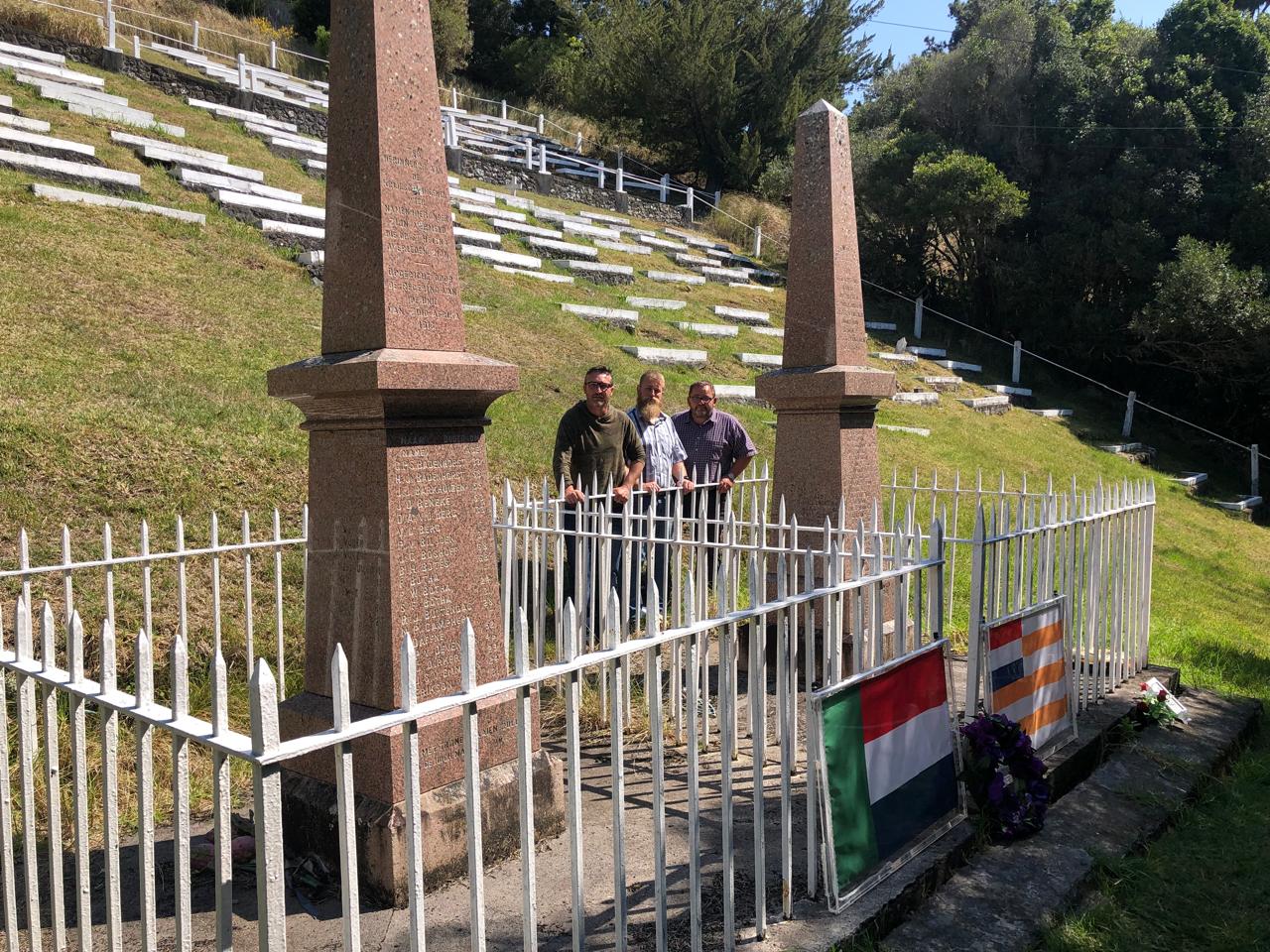
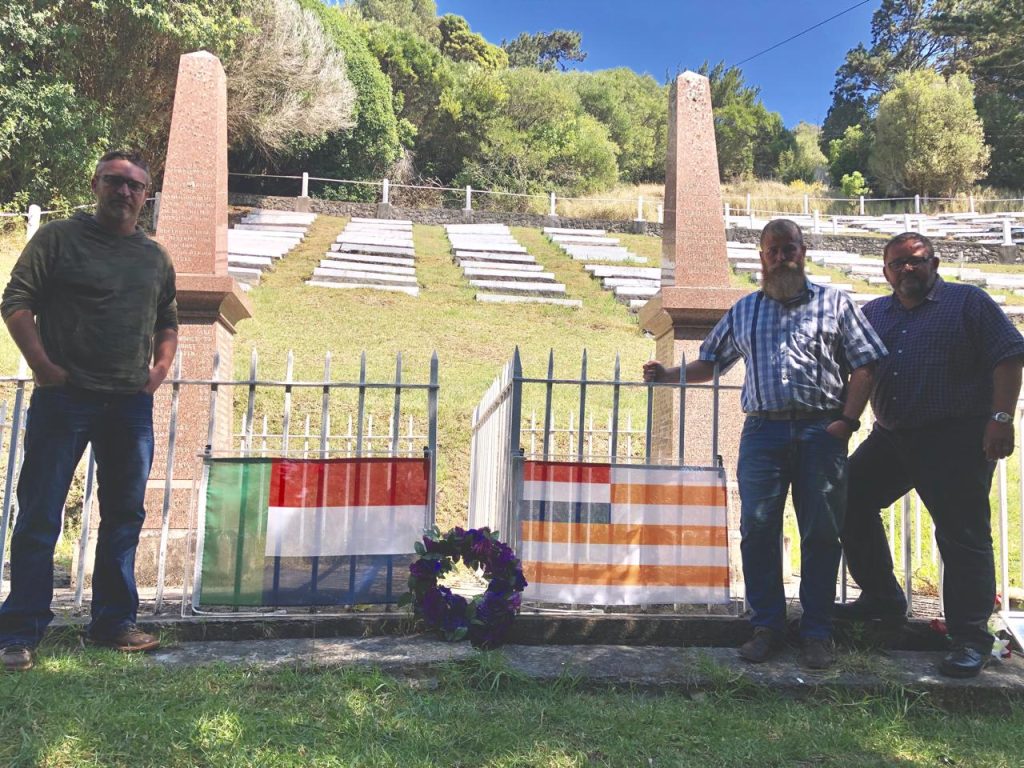
All did not leave the island though. A few married locals, while 180 died and were buried there. Finding a final resting place for them was not easy. The local Anglican Church considered them tob e enemies of the British throne and heathens, and consequently refused to allow them to be buried in the Anglican cemetery. The Baptist Church then stepped in and donated land at Knollcombes, where a cemetery was established for them. In addition to the numbered graves, two obelisk-shaped monuments were eventually also erected there. These monuments which were sent to St Helena by the South African government in 1913. The names of the deceased appear on one of them. Initially, the Baptist Church took care of the graves, but since 1945, this task has been performed by the government of St Helena.
AfriForum’s Kallie Kriel visited the cemetery in 2019. A video produced at the time is available on AfriForumTV and includes more interesting information about this chapter in our history.
Many other interesting sources can also be found. Sgt. Jack Thorpe was assigned to accompany Gen. Cronjé at the time and one can listen here to an interview conducted with him in later years here. There is also a list of names of all the Boer prisoners of war who were held on the island and of those who are buried there.
Since the establishment of a runway in 2017, St Helena has become more easily accessible than when it was solely dependent on shipping, but it remains one of the most remote places on earth where the tracks of Boer ancestors can be found.
Also read: The amazing Emily Hobhouse
Share on

Latest articles