

Nature’s Corner 77 – Join us for a virtual game drive in the Kruger National Park
This time of year, many people’s hearts are drawn to the bush or veld. Some go hunting, others visit one of the country’s beautiful game reserves. Imagine today that you are traveling with André and Katie Christof in the Kruger National Park. André says:
One year, at the end of May, we were booked for a two-night stay at Olifants Rest Camp in the Kruger National Park.
The camp is located on top of a foothill of the Lebombo Mountains, which stretch from Hluhluwe in KwaZulu Natal in the south, through Swaziland to Punda Maria in the north of the park. From the eastern side of the camp, the mountain range extends into Mozambique, where it is known as the Montes Libombos.
The Olifants River flows from the west below the camp all the way past the mountain range into Mozambique, where the Rio dos Elefantes (as it is known there) later joins the Limpopo River.
We leave home early in the morning and enter the Kruger National Park at Orpen Gate two hours later. It is a lovely, clear day, with not a cloud in sight. The sky is a pastel blue, as blue as it can only be at this time of year in the Lowveld. Around nine o’clock we enjoy sandwiches that Kate packed for us at home early in the morning with a cup of coffee, ten kilometres before Satara Rest Camp next to the Nsemani Dam.
Later we quickly visit the camp, walk around the shop, linger for a moment at the souvenirs and the books, pick up one or two.
Then we continue our drive.
The knoppiesdoring-marula-savannah stretches from Crocodile Bridge in the south to Witpens Waterhole (which is located 5 kilometres north of Satara). From there, the bush-knoppiesdoring-savannah continues with vast open grasslands, the waving grasses stretching on as far as the eye can see, to the area around the Ngotso Dam (18 kilometres north of Witpens Waterhole) and Nyamarhi Waterhole, just north of the dam. The dam was closed about 10 years ago and the weir destroyed.
In the past, we often encountered guinea fowl scurrying in long lines across the veld to the waterhole during the winter months.
Then, at times, we watched huge herds of buffalo there on their way to the dam. The dull thud of their hooves on the hard earth as they came striding with their heads held low across the veld with the sound getting louder and louder, was something incredible to experience.
Awesome!
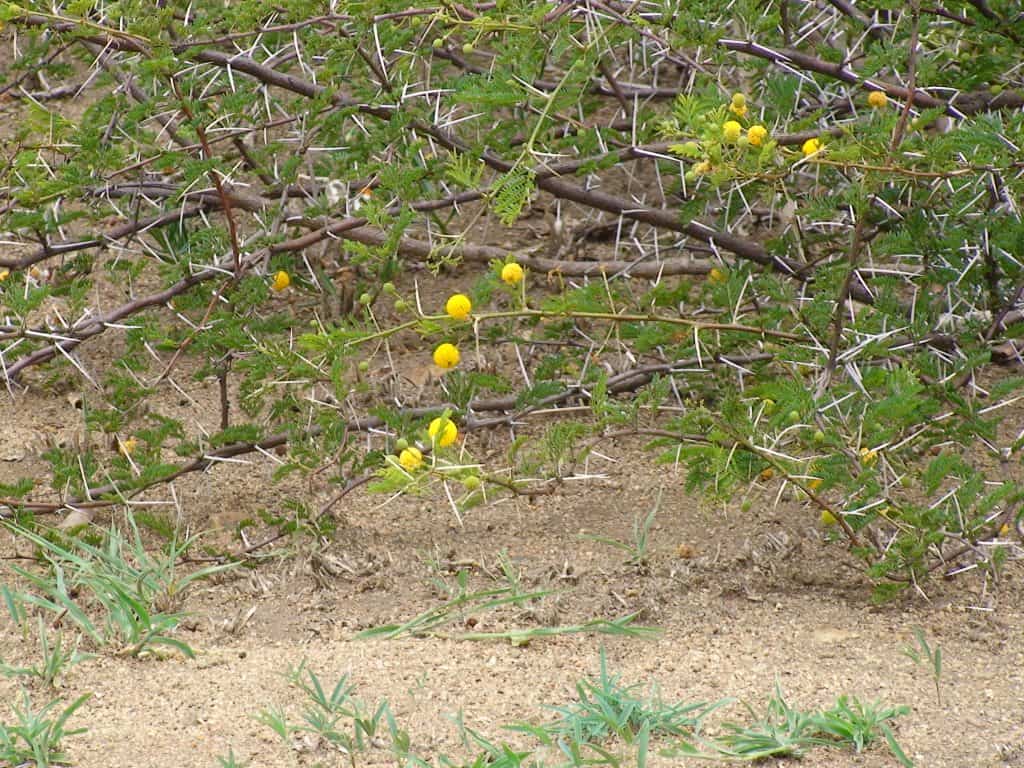
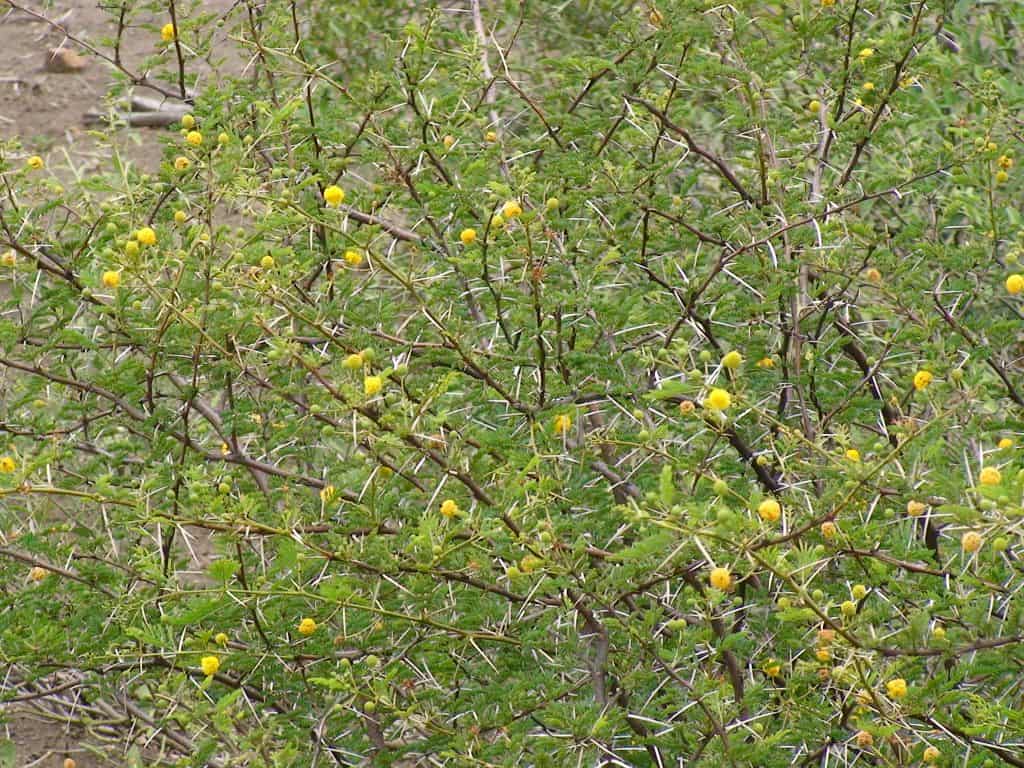
In the area north of Ngotso, we had a peek, each with a sweet in the cheek, at the thorn bushes, with their thorns sticking out like miniature horns on the branches.
At this time of year, the branches of these shrubs are bare, they abound on the grassland. They are deciduous shrubs with multiple trunks but can also be found in a tree shape with a slender crown. Such a tree can reach a height of up to 5 metres. In the summer months, their pure white thorns stand out beautifully against the double-pinnate compound leaves with the smallest feathery fronds. At that time of the year, it bears tiny, fluffy, round, golden-yellow flowers.
A while later we stop on the bridge across the wide Olifants River and get out of the car to stretch our legs. We look at the river from the long steel railings along the side of the bridge. Every now and then these railings make a loud, metallic clanking sound along their length – a sound that reverberates in the air for a few seconds.
Little swifts soar in the air in flocks on either side of the bridge. Every now and then a group fly past us. Chirrrrrr, chirrrrrr, chirrrrrr, chirrrrrr, they chirp as they swoop after insects. Some of them dive under the bridge, then they race up into the sky again on the other side chasing their food.
To the right of the bridge, you can only see rocks and the water flowing strongly down the left bank into the river. On the other side of the bridge, upstream, there are a multitude of Egyptian geese lying in a row. On a huge sandbank near the water, some of the males sit nodding their heads, while now and again they make hoarse hissing sounds.
A little way from them we notice a group of vultures standing about. Most are white-backed vultures, many of which have their wings with black tips and dark brown insides spread open. Their heads and long, almost bare rubbery necks are covered with down and graceful white feathers sit between the shoulders at the bottom of the back of their necks.
There are also a few lappet-faced vultures and an Egyptian vulture, which is a small kind of vulture.
The lappet-faced vultures have massive beaks, bare pink heads, large, fleshy folds of skin on the sides of their necks, mainly dark feathers and white thighs. They have a wingspan of up to 3 meters and stand almost 1 meter tall.
Two white-headed vultures can also be seen. They take long strides, hunched over with their heads bent low between their shoulders. They have featherless, almost triangular heads. On top of each white head a small, soft, white crest can be seen. They also have curved, pointed bills, white feathers under their bodies and around their lower legs, with powerful, sharp, curved talons. Their upper chest, back and wings are a mottled brown, while their bellies and underfeathers are white, contrasting beautifully with their black tailfeathers. Their feet are a light pink.
But what a face the white-headed vulture has to behold! It has a dark red beak and light blue waxy skin around the beak, brown eyes, and a rosy hue along its mostly featherless neck and face, creating a virtual pastel rainbow!
Kate packed us a light lunch at home, which we want to eat under shady trees along the river on the other side of the road turning off to Olifants Restcamp. We drive on and follow the road up the foothills of the Lebombo Mountains.
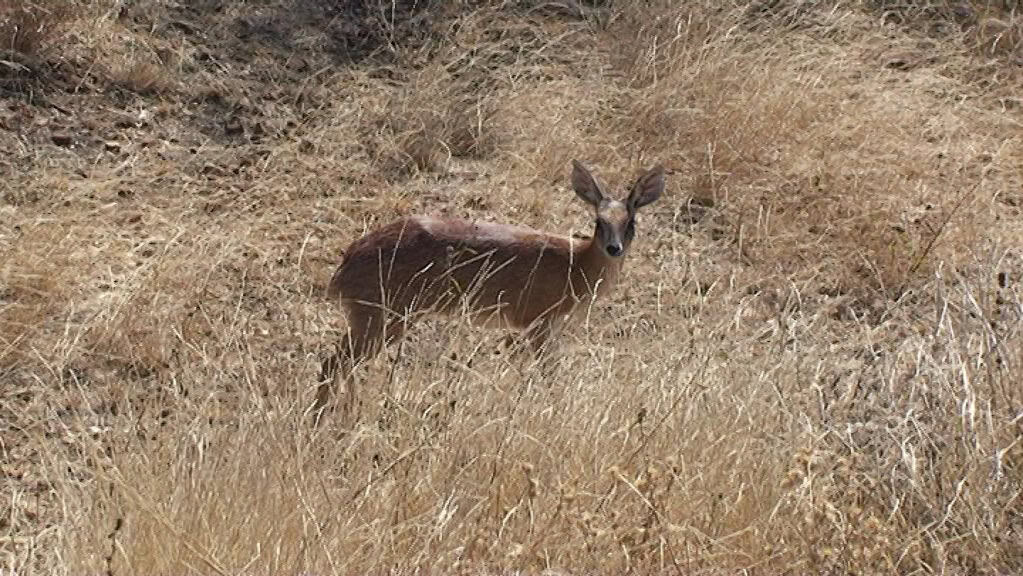
Near Balule Satellite Camp, close by on the right side of the road, we notice a Sharpe’s grysbok ewe standing among long, dry, pale brown grass, looking out over the veld, her ears pointed.
I stopped very carefully a short distance away from her.
It is a small, timid kind of antelope with a stocky body and a shoulder height of probably no more than forty centimetres. It has thick, elongated fur on its back and large ears. The rich reddish-brown fur with white streaks in the hair on the back and sides gives it a greyish appearance; its eye rings, snout, throat and underparts are an off-white.
We have only seen Sharpe’s grysbok once before, as they are mainly nocturnal and are found in hidden habitats. They often crouch low to the ground while running or when being chased. The males have blunt horns, which are widely spaced.
After a while, she turns one ear to one side, also her head as she listens, then she turns her head to the other side again, while also turning the right ear back. Next she looks ahead again, but now with both ears pulled flat against her head. We can see the beautiful white hairs inside her ears, the rusty brown of her fur that runs like a vein through them to the tips, branching into three on one side, giving it the appearance of small leaves.
The next moment it looks as if she wants to run away, head held low. She stomps, shakes her head, wags her tail a few times in rapid succession. Then she stands motionless for a moment, hunched over, peering in our direction with her big, round, shiny eyes, shaking her head, making her ears flap.
Suddenly she turns back to lick her back, turns back, jumps away, then she almost immediately stops again, looks in our direction once more, straightens up and wags her tail. Her skin trembles at her shoulder and she delicately licks the side of her mouth with her little tongue.
After a while she bows her head, steps lightly over twigs and, while sniffing the ground, disappears behind the long grass, out of sight.
Then it is time for us to drive on …
Also see: Nature’s Corner 76 – Flora
Share on

Latest articles