

The tradition of planting a tree to commemorate a special event or honour a person is centuries old and is embedded in cultures around the world. Trees are considered to be symbols of growth, strength and endurance. When a tree is planted to commemorate something, the act not only pays tribute to the past but also creates a link with posterity.
In the town Nääs in Sweden, there is a birch tree that was ceremonially planted to commemorate a special bond between Afrikaners and Swedes. It was planted on 5 June 1953 by Dr. Samuel Henri Pellissier during his visit to Nääs with 100 folk dancers and their leaders. He planted this living monument in memory of his visit to the town in June 1912 when his exposure to European folk songs and dancing inspired him to start the Volksdans Movement in South Africa.
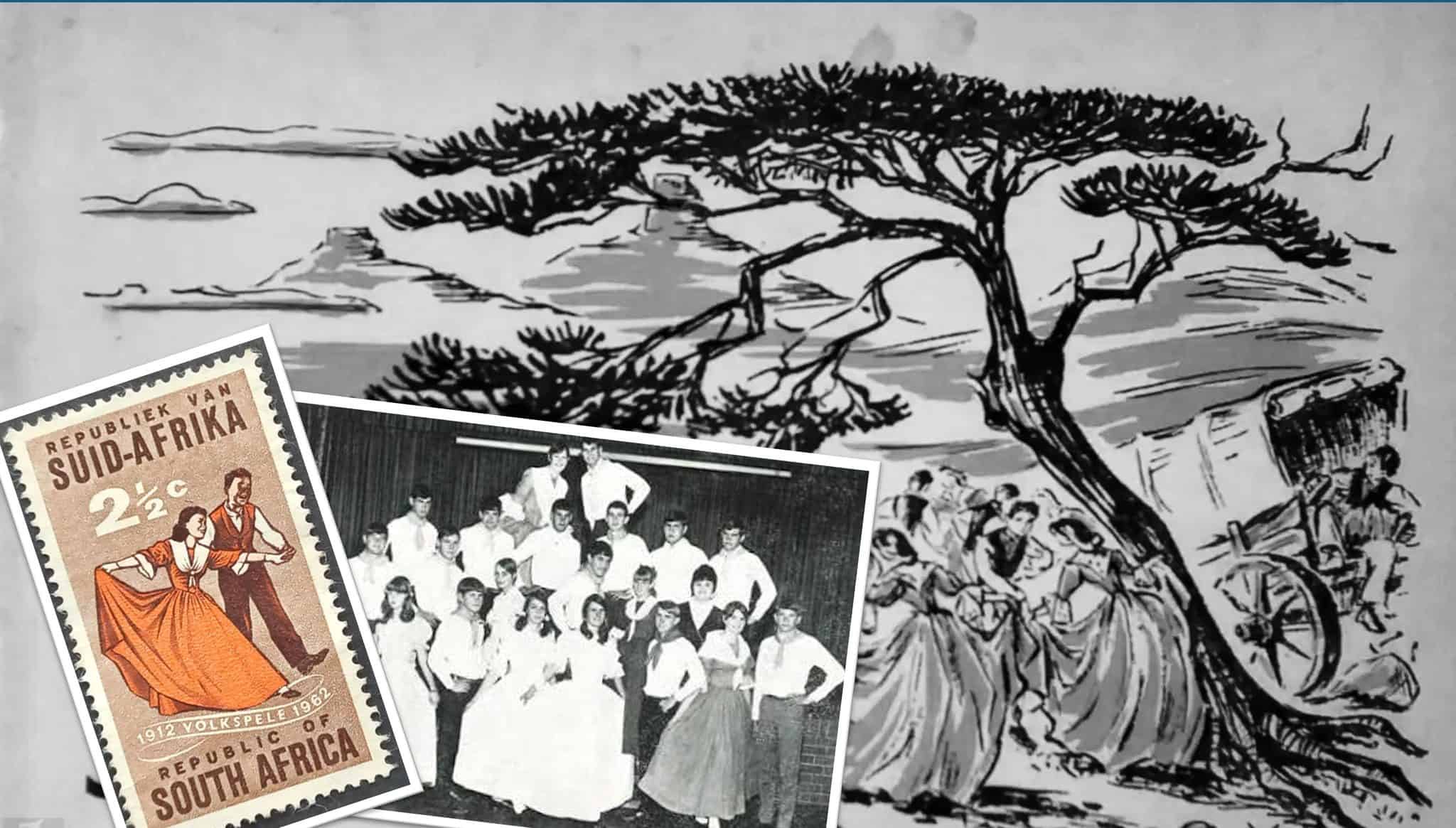
Most communities in the world have traditional dances, music and singing. At the beginning of the twentieth century, Afrikaners with our diverse origins also played so-called picnic games with dancing, music and singing, but these dances were not formally organised or even recorded.
In 1912, three teachers, namely Pelissier, John Murray Meiring (later principal of Grey College in Bloemfontein) and Francois Jacobus le Roux (later principal of Afrikaanse Hoër Seunskool in Pretoria) visited Europe on scholarships granted to them by the Orange Free State Education Department to hone their teaching skills. After time spent in the Netherlands and Germany, Pellissier and Meiring went to Sweden where a course in woodwork and carpentry was being taught. They were keen to establish it as a school subject back home. The course was held at Nääs Castle. This impressive building has a documented history dating back to 1529. In 1868 it was sold to August Abrahamson, which resulted in the establishment of the August Abrahamson Foundation that is continuing to promote traditional crafts there to this day.
People from all over the world, including the two young men from South Africa, visited Nääs in 1912 to learn crafts and in the evenings, proudly dressed in their national costumes, performed folk dances and made folk music. Pellissier realised that this was something that Afrikaners did not have.
After his return to South Africa, he started establishing a formal folk dance movement. In 1914, while he was the deputy principal of the Afrikaans school in Boshof, he adapted four Swedish songs with the necessary rhythmic dance movements. These were introduced to the locals on 28 February 1914 during a Sunday school picnic. The dances immediately became popular amongst the youth of Boshof and interest grew. Local songs and games were then formalised and added to the repertoire by him. After he had been appointed as Director of Education in the Orange Free State in 1926, he was also able to ensure that these folk dances became nationally known and loved.
Later he required that the folk dances should be performed in appropriate traditional attire, namely the outfits based on Voortrekker clothing that we know today.
The Symbolic Ox Wagon Trek of 1938, the inauguration of the Voortrekker Monument in 1949 and the Van Riebeeck Festival of 1952 encouraged interest in these dances – especially due to the impressive mass performances created by Mrs. Cecile de Ridder, with several thousand performers who were part of the programmes at these events. For her role, “Tannie Cecile” was awarded a medal of honour by the Suid-Afrikaanse Akademie vir Wetenskap en Kuns in 1965. She also wrote several books on folk dancing.
In 1953, the first Afrikaner folk dancing tour to Europe took place. The group performed in England, the Netherlands, Belgium, Germany, Denmark and Sweden – the first of several such tours by dancers through the years.
For Pellissier, the highlight was probably retracing his steps to Nääs Castle. The group was warmly welcomed there and Swedish folk dancers presented Pellissier with a young birch tree with the request that he plant it in commemoration of the origin of the Afrikaner folk dance movement at Nääs all those years ago. A bronze plaque with the following inscription in Afrikaans and Swedish was added:
THIS TREE WAS PLANTED BY DR. S.H. PELLISSIER ON 5 JUNE 1953 DURING THE VISIT TO NÄÄS OF 100 SOUTH AFRICAN FOLK DANCERS AND THEIR 10 LEADERS AS A MEMORIAL TO REMIND US OF THE FACT THAT IN JUNE 1912
HE WAS INSPIRED BY THE SWEDISH FOLK DANCES AND FOLK SONGS TO PROMOTE THE AFRIKANER’S OWN FOLK DANCES AND FOLK SONGS IN SOUTH AFRICA WITH LOVE AND DEDICATION.
In later years, Swedish anti-apartheid views strained relations between Afrikaners and Swedes, but the tree still casts its shadow at the castle as a reminder of the inspiration a young teacher found here, and which was the origin of the modern-day Afrikaanse Volksang- en Volkspele Beweging (AVVB).
More information about the AVVB is available at volkspele.co.za, while the website of Nääs Castle at naas.se/en/ provides information about its history, current courses and even affordable accommodation options at the castle. If you ever have the privilege of being close by, remember to go and say hello to this tree with its unique history.
Share on