

In previous articles, we referred to the camps on St. Helena (https://wereldwyd.co.za/en/boer-graves-on-st-helena/) and Sri Lanka where Boer prisoners of war were kept during the Anglo-Boer War.
Bermuda, an archipelago of 181 islands about 1 035 km west of the USA, was the fourth overseas destination to which Boer prisoners of war were sent. After the British Imperial Government decided that Bermuda would host them, land was leased on various islands in the group from the Bermuda Government, the British Admiralty and private owners. On 26 June 1901, the first ship arrived with 963 men and boys on board.
Eventually more than 5 000 prisoners of war were held there. According to an article by Thomas V. James on TheBermudian.com, the oldest of them was 80. They also included about 180 boys between the ages of 6 and 16. Some of these boys were transferred to a boarding school on Hinson’s Island in March 1902.
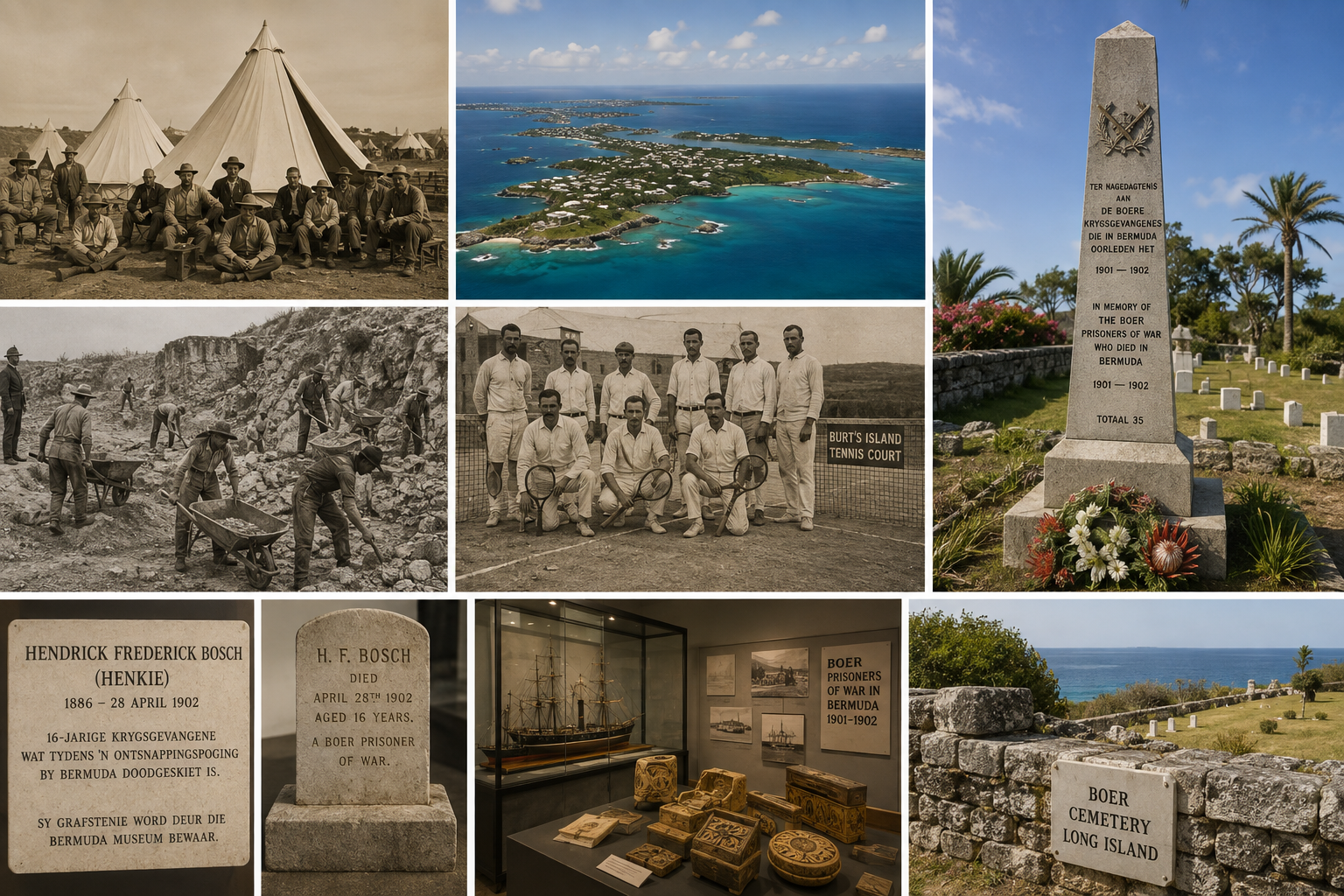
It is remarkable that extensive, well-ordered camps could be prepared within a few months. Water supply on the small islands was a challenge and water tanks and distillation equipment were set up in the camps. Guards and prisoners were housed in bell-shaped tents. Conditions in the camps were reasonably good, and deaths were limited to 35, of which 34 passed away of natural causes and one was fatally injured during an escape attempt. The illnesses from which the 34 died, included pneumonia, consumption, typhoid and heart ailments.
The victim of the failed escape attempt was 16-year-old Hendrick Frederick Bosch, better known as Henkie. His father was a Dutch-born lawyer who had settled with his family in Pretoria years before. During the war, the father remained in Pretoria, but Henkie joined the Pretoria Commando at the age of 13. He was wounded in a battle near Ladysmith in Natal on 6 January 1900. He apparently returned home afterwards. He was captured in Pretoria on 5 June 1901 and sent to Bermuda. According to witnesses, a British guard there constantly hinted to the prisoners that he would help anyone to escape. The Boers did not believe him at first, but on the evening of 28 April 1902, he gave a signal that it was safe to slip out of the camp, whereupon Henkie took the chance as the first of a group to do so. He became entangled in the barbed wire surrounding the camp and was shot dead there. His tragic death, so shortly before the conclusion of peace, was a tremendous shock to his parents and his father died on 29 December 1902 of a stroke at the early age of 43.
The most notorious prisoner of war in Bermuda was probably Fritz Joubert Duquesne, known today as a spy, war correspondent, hunter and confidence trickster. According to his own accounts, he escaped from Bermuda to the USA, where he accepted citizenship in 1913. After many adventures, he was arrested by the FBI in 1941 as the leader of what was, up to that date, the largest espionage network in US history. He was released in 1954 on grounds of ill health and passed away two years later in New York.
Boredom is always a big problem among people in detention. The prisoners of war kept themselves busy with crafts and sports, among other things. Examples of their prisoner-of-war art can still be seen in Bermuda’s National Museum. A tennis court was even constructed on Burt’s Island. The Transvaalers and Free Staters enjoyed relative freedom during the day, but the Cape Rebels had to perform forced labour in a quarry.
A monthly report dated December 1901, preserved in the British National Archives, tells us more about the mood of the people in the camps. In this report, Major L.E. Morrice (assistant adjutant-general for prisoners of war) reports to His Excellency General Sir Ge Digby Barker (commander of the troops in Bermuda) that although the majority of the citizens of the Boer republics would probably be prepared to submit to British rule at the end of the war, their hearts would remain with their lost republics. He was sure that they would always cherish the hope of regaining their independence. He concluded that their nationalism was all but extinguished.
A mere eleven months after their arrival, a peace treaty brough an end to the war and the camps began to empty. Prisoners of war who could pay their own passage left soon after the conclusion of peace, others had to wait for transport provided by the British. The last of these ships left for the Cape on 21 January 1903. Those who refused to take the oath of allegiance to Britain remained on the islands. They gradually left and by 1910 only 9 of them remained. No descendants of the Boers are to be found on the islands today. Although few traces of the camps can still be found, residents have thoroughly documented this chapter in the history of Bermuda. The National Museum includes exhibitions about it.
Furthermore, a memorial commemorates their time there. Shortly after peace had been concluded, the Boers decided to erect an obelisk in memory of their deceased comrades in the cemetery on Long Island. Individual graves were also marked with headstones. The obelisk was erected with the full support of the British military authorities. The committee responsible for the restoration of the local cathedral was involved, and the obelisk was blessed in 1903 by the Bishop of Newfoundland and Bermuda. It is carved from Nova Scotia Freestone, with a base of Bermuda limestone. The names of the 35 who died, as well as other prisoners of war who perished during the voyage to Bermuda and were buried at sea, appear on it. During the apartheid era, the Boer Cemetery and obelisk were neglected, but in 1997 local islanders David Lines and Andrew Bermingham, Bermuda’s National Trust and the South African government joined forces to restore it. The broken and crumbling headstones were replaced, but two of the original stones are still preserved by the Bermuda Historical Society Museum – one of which is that of Henkie Bosch.
The fact that the local residents take such good care of the few traces that remain of the Boer prisoners of war is heartening. Despite their short and sad sojourn on the islands, they have not been forgotten.
Share on

Latest articles