

Alana Bailey
Marthinus Theunis Steyn (1857-1916) was the last president of the Republic of the Orange Free State. He has been described as the “Afrikaner of the Afrikaners” and the “soul of the freedom struggle” of Afrikaners.
This extraordinary man was born on 2 October 1857 in the Winburg district, the fourth of eleven children. After his schooling at Grey College in Bloemfontein, he initially helped on his father’s farm, but in 1877 left for the Netherlands to continue his studies there.
A fascinating piece of history about his voyage to Europe is that President Paul Kruger was on the same ship. At the time, Kruger was a member of the first delegation of the former Zuid-Afrikaansche Republiek. He was already in his fifties, while Steyn was a young man of nineteen. Just imagine if one could have been a fly on the wall to hear what they talked about during the voyage!
Arriving in the Netherlands, Steyn and his friend Harry Vels prepared for the entrance examination of the University of Leiden. They were helped by two lecturers of the gymnasium in Deventer. At first Steyn and Vels lived with Vels’ aunts in the village of Twello, but after they had begun their preparatory studies, they rented rooms from a grocer in Deventer. In 1879, however, they decided to go to England, where Steyn completed his law studies at the Inner Temple in London.
In December 1883, he returned to the Free State as a qualified lawyer. He quickly rose in the legal profession: At the beginning of 1889, he was appointed as State Attorney of the Free State and in 1892 as Chief Justice. In March 1896, he was inaugurated as President of the Republic.
Steyn was in favour of cooperation with all possible partners, but was also intensely aware of his Afrikaner identity and passionate about his people and language. Before the outbreak of the Anglo-Boer War on 11 October 1899, he tried his best to prevent military conflict but thereafter took a strong stance against surrender. By the end of the war, he was a very ill man. On 30 May 1902 he was forced to resign as president. He was almost completely paralyzed yet remained in the camp at Vereeniging with his men.
In July 1902 Steyn and his wife left for Europe in order for him to receive treatment for his illness. The Boers’ courageous resistance against Britain captured the imagination of the Dutch. He received a hero’s welcome. Some of the Dutch supporters had also participated as volunteers on the side of the Boers during the war. One of them was J.C. Kakebeeke, a resident of Deventer. He met Steyn while on commando, and the President made such a deep impression on him that he advocated for a statue of Steyn to be erected in Deventer.
Kakebeeke and a friend of Steyn, Dr. Houck, approached the Nederlandsch Zuid-Afrikaansche Vereeniging (NZAV) with this proposal and later also involved Dr. H.P.N. Muller, a former consul-general of the Free State. A commission was established under the chairmanship of Muller to handle the issue. Sculptors could submit their proposals for the statue, and they eventually decided that the artist Toon Dupuis would receive the commission. At that time some of his famous works already included images of the artist Rembrandt and of the brothers Cornelis and Johan de Witt (political leaders of the seventeenth century).
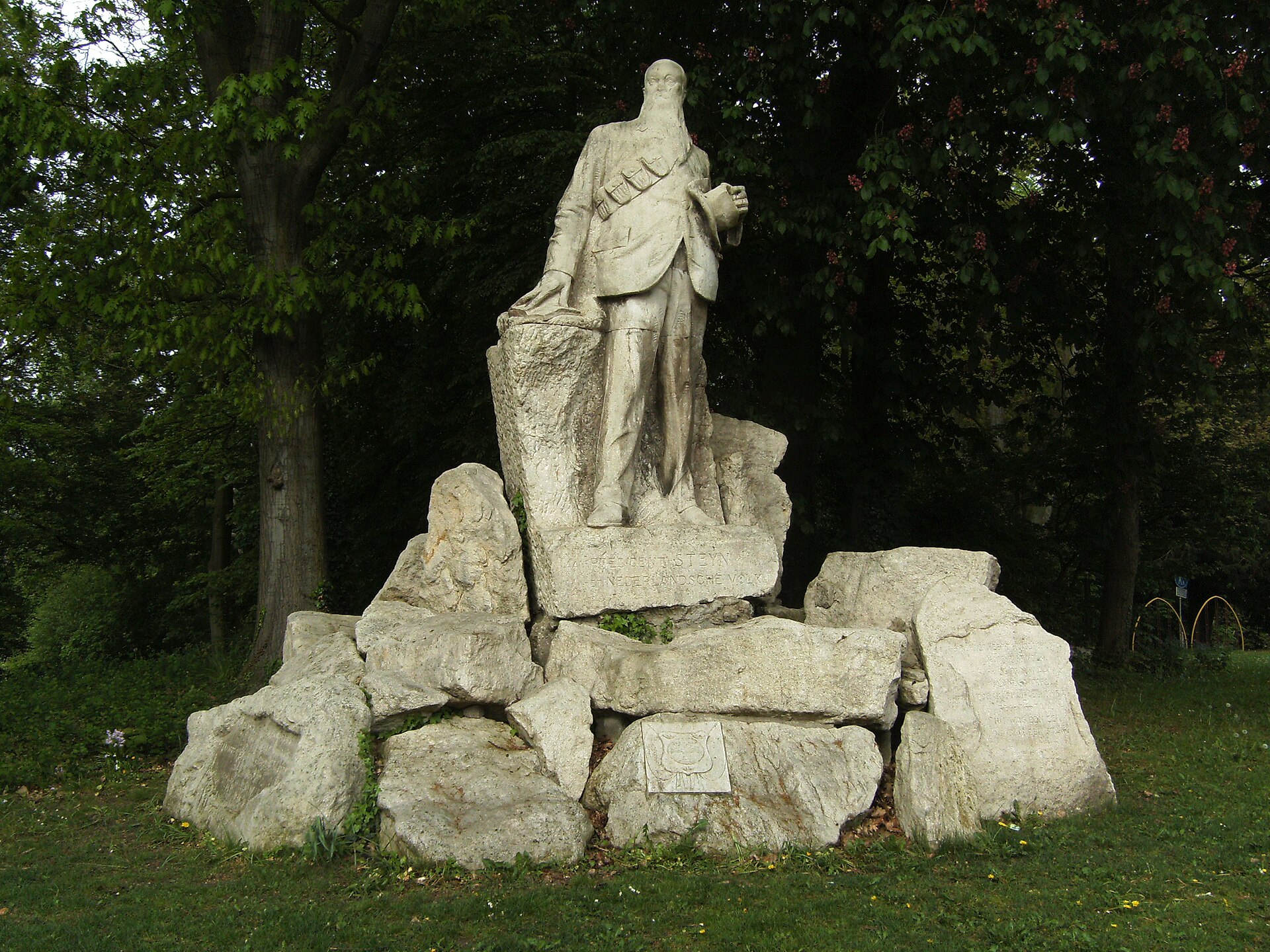
Dupuis decided to depict Steyn as if he were in the veld, encouraging his citizens. The statue shows Steyn with his bandolier around his body and his hand on the Bible, while standing on boulders. The Deventer city council made land available near the train station where the statue was erected.
It was officially unveiled on 6 July 1922 by Steyn’s daughter, Gladys Steyn. After the ceremony at the statue itself, the proceedings continued in the nearby St. Lebuïnus Church. The programme included the reading of a telegram sent by General J.B.M. Hertzog, as well as the national anthems of the Free State and Transvaal. A reception followed in a hall decorated with the Free State flag. It was hoped that the statue would not only celebrate Steyn’s role and legacy but would also strengthen ties between the Netherlands and South Africa.
This was the first statue of Steyn ever erected. It still stands at the same place in Rijsterborgher Park in Deventer. Next to it, there is a sign with the words: “Geen offer heeft hij geschuwd voor zijn volk, voor de trouw aan ‘s lands woord voor onafhankelijkheid, recht en taal. Hij was een eer aan onze staat”.
During the apartheid years, the statue was often vandalized with paint and on one occasion a group apparently tried to set it on fire, but it was always restored. Due to the more recent Black Lives Matter protests and the anti-colonialism debates, the statue became shrouded in controversy once again by 2020. There were suggestions that it should be removed, or that more context should be given to it with another sign, or by erecting a contrasting statue next to it.
The public’s input was sought, and sixty proposals were received. Some of the artists’ submissions were printed on banners and temporarily displayed next to the statue. Posters were also put up elsewhere in Deventer. Eventually, three artists were invited to develop their ideas in more detail. They even held a public debate about this topic, a recording of which is available online (https://buitenkunstindeventer.nl/tegenbeeld/).
As far as could be determined, the whole issue then lost momentum. The feeling was that deciding on one option would undermine the wealth of other ideas. A follow-up project was discussed, but whether this happened is unclear.
In 2025, older Dutch people, in response to a photo of the statue on the “Herinner je Deventer” Facebook group, indicated that the statue remains to be a beloved part of their cityscape. It is where lovers meet and where the crocuses bloom beautifully in spring. Today the president still stands proudly, gazing at a world that is just as uncertain as it had been a century ago.
Share on

Latest articles