

Those who died “with lives unfinished” – South Africans remembered in Romania
By Alana Bailey
Romania is a country that is relatively unknown to most of us, yet even there, traces of South Africans can be found, and they are still being commemorated.
In the previous instalment of our series about places abroad with ties to South Africa, we recalled the brave airmen who participated in the Warsaw Airlift during the Second World War (1939–1945). This month’s contribution also deals with casualties of the Second World War, focussing on five South Africans who paid the ultimate price in the skies above Romania.
The first two were part of 178 Royal Air Force (RAF) Squadron. This squadron was a bomber unit based in Egypt, Libya and Italy during the war, equipped with Consolidated B-24 Liberator bomber planes. Its motto was Irae emissarii, which is Latin for “Emissaries of wrath”. After serving in Egypt, the squadron moved to Libya, and then from March 1944, to Italy.
On 8 May 1944 one of the Liberators took off on a bombing mission from Foggia in Italy. The crew comprised the pilots, lieutenant Jan Gerrit Cornelis Schuurman and flight sergeant Peter Bissett, and three air gunners, lieutenant Dean Patrick McGee, as well as flight sergeants James Alexander Phillips and Kenneth William Brown. Schuurman and McGee were South Africans and members of the South African Air Force (SAAF), seconded to the RAF. With 100% moonlight on this night, it was an extremely dangerous mission. The plane was attacked by a night fighter and crashed in flames near the small Romanian town of Lunguletu. All members of the crew were lost and they were buried in the Bucharest War Cemetary.
Schuurman was born on 7 March 1923 and therefore had just turned 21 at the time. He was the son of Jan Gerrit Cornelis and Maria Margaretha (nee Erasmus) Schuurman. A commemoration stone was erected in his memory in the Geduld Cemetery in Springs.
McGee was 28, born on 10 July 1915, the son of Thomas Sarsfield McGee and Ellen Mary Gardner (formerly McGee), of Voortrekker Street, Lydenburg. He had previously been a farmer.
178 RAF Squadron later also was actively involved in the Warsaw Airlift. It was disbanded when the war came to an end.
The second incident claimed the lives of three members of the South African Air Force (SAAF) and one British member of the Royal Air Force Volunteer Reserve. The South Africans were of 31 Squadron of the SAAF. This squadron initially was a coastal bomber and reconnaissance unit. Later it converted to a heavy bomber squadron, operating from bases in the Mediterranean from January 1944 to the end of the war. Thereafter it was used to take liberated prisoners of war from Italy to Britain, as well as disbanded South African troops from Italy to Egypt. On 15 December 1945 it was disbanded, but from 1982 to 1992 resurrected to serve as a medium and light helicopter squadron.
From 16 June 1944 the squadron also started operating from Foggia in Italy and focused on strategic targets in the Balkans, Hungary, Austria, Romania and northern Italy. On 3 July 1944 pilot second lieutenant Edward Nowers and airgunners warrant officer Leslie Amyas Preston, second warrant officer James Vincent Pullon Robertson and flight sergeant Fred Ryder (the volunteer reserve member of Lancashire), as well as two other unnamed crew members took off from Foggia on a mission to attack the Prahova Oil Refinery at Bucharest. Again the mission was extremely dangerous due to 88% moonlight, which made any plane quite clearly visible. Their Consolidated B-24 Liberator VI was attacked and shot down by a night fighter, crashing at the Romanian village of Furculești. The unnamed crew members seem to have survived, but Nowers, Preston, Robertson and Ryder died. They were also buried in the Bucharest War Cemetary.
The introduction of radar and stealth features in aircraft on both sides, revolutionised night air combat – for the first time turning the night sky into a battlefield.
The night fighters responsible for shooting down both planes, were either purpose-built planes or modified day fighters used to combat aircraft at night. They were equipped with technology that was revolutionary at the time in order to be able to ambush enemy bombers while remaining as invisible as possible. It also enabled pilots to land their aircrafts in darkness, as runway lighting exposed airfields to attacks. The introduction of radar and stealth features in aircraft on both sides, revolutionised night air combat – for the first time turning the night sky into a battlefield.
In this second incident, the three South Africans were interred in a joint grave, but with individual headstones.
Nowers was 35 years old, the son of Philip and Susan Marion Nowers. He was married to Sylvia and lived in Klerksdorp. A commemoration plaque in his honour can be found at the Plettenberg Bay St. Peter’s Anglican Church. The SAAF motto “Per aspera ad astra” appears on his headstone in Romania.
Preston was 20, the son of Bertel and Nora Preston of Benoni. In addition to the headstone in Romania bearing the words “Death is but a gateway”, a commemoration stone in his honour was erected in Rynsoord Cemetery in Benoni.
Of Robertson, surprisingly little is known.
The headstone of the Brit, Ryder, bears the poignant inscription “Loving memories of our son, who gave his unfinished life for his country”.
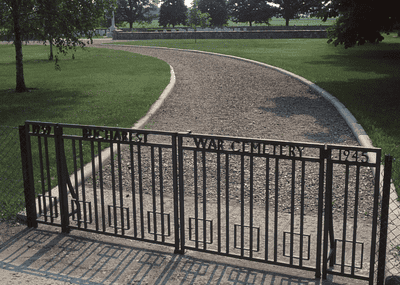
Bucharest War Cemetery is being maintained by the British War Graves Commission and appears to be in a very good condition. Any South Africans visiting Bucharest should consider paying a visit to pay homage to these five brave young men who found a final resting place so far from home.
Also read: South Africans’ brave participation in the Warsaw Airlift of 1944
Share on

Latest articles