


By André Christof
André (author of the Op vlerke series of books about nature) and his wife Kate like to visit the Kruger National Park. During one of these visits, they witnessed a leopard’s escapades:
One morning after an overnight visit to Letaba Rest Camp, Kate and I stopped on our way to Skukuza, about eight kilometres south of the Olifants River, at Ngotso North Waterhole. We watched a lappet faced vulture standing quite some distance away to the left of the road, next to the watering hole in the veld, its head tucked between its shoulders.
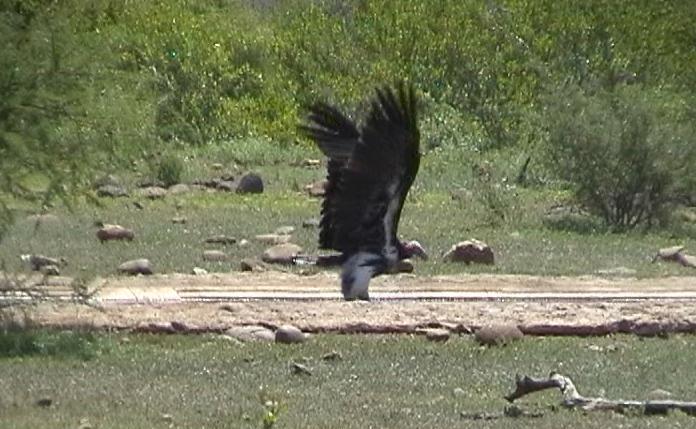
It is an impressive vulture with a massive curved, sharp-pointed, yellowish beak, the largest vulture in the region. It has a bloodred bare head and neck, folds of skin on and on the sides of its head, large fleshy folds of skin on either side of its neck and long feathers on its collar. The predominantly black bird has a white-striped breast with white “pants”, bare white legs that contrast with the dark body and underwings, as well as powerful, strongly curved talons.
Eventually he walked to the watering hole, climbed onto the cement wall, his long, wide wings spread out in a V-shape above him, the white stripe across the front of his underwing clearly visible. Then, balancing and kicking his feet, he slid into the water.
He stood there for a while, completely still, his wings still unfurled, then he walked a little way forward, climbed out to the side, but not for long, closed his wings, and started to trot with long treads, flapping his wings slowly, and finally he rose up into the sky.
A few kilometres further on we approached the Ngotso River, which meanders past to the left of the road. On both sides of the road the veld was green, lightly wooded with trees some distance away along the river.
We were driving slowly now, as we looked to the left, and then to the right.
Suddenly we saw a movement in the long grass to the right of the road.
Now we were driving extra slowly, searching, watching …
Then, at a spot about twenty meters from the road among a few trees, we noticed another movement, something with a yellow-brown colour, just for a fraction of a second. The next moment, a leopard jumped into a tree as fast as lightning, scurrying frantically up the branches.
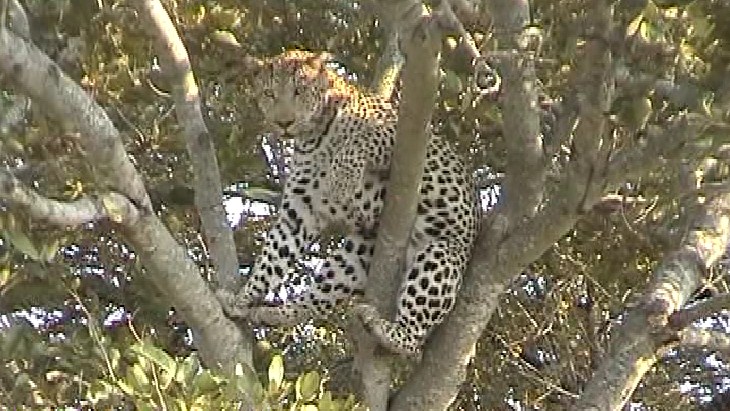
Initially the leopard tried to find a place to stand, but there were no branches horizontal enough to stand on, so the young female was struggling.
Later she climbed higher, trying to sit somewhere, but she could not find a suitable perch either and eventually settled uncomfortably among the branches. Her hind legs hung down on either side of the branch in front of her. She sat hunched over with a branch passing under her rib cage to the left. Her left buttock pressed against the branch behind her – she was wedged in there, propping herself up, with a front leg stretched diagonally downwards, against a branch to the right in front of her.
What a beautiful animal she was – her fur looked so soft! Her chest, lower neck, belly and the insides of her legs were white with black spots, the strawberry-shaped spots on her chest and lower neck merged to form a collar. The yellow-brown of her head and lower limbs also had black spots, with black spots in the form of rosettes on the remainder of her body’s yellow-brown fur.
One felt sorry for her as she sat there, a little way from us: The magnificent, elegant animal with her long white whiskers looking completely forlorn with her yellow eyes staring straight ahead.
Every now and then she tried to pull herself up with her hind legs to change position, but after struggling she remained hunched down in that spot.
One could see that this was certainly not the best tree that the young animal could have chosen in her haste, nor one with the thickest trunk or branches, but there was no time either, she just wanted to get off the ground as quickly as possible.
As the leopard was sitting there, we could see her staring out across the field behind her every now and then. We tried to see what she was looking at. Later we noticed a few lionesses lying under trees in the long grass, quite some distance away. Only their heads were visible ever so slightly, but they were lying with their backs to the road, looking out across the veld in front of them. It did not seem as if they were interested in her at all or were even aware of her.
Later the leopard got tired of sitting so uncomfortably in the tree, her mouth open as she was breathing hard. She shifted her legs, straightened herself and stood up, gripping onto two separate branches.
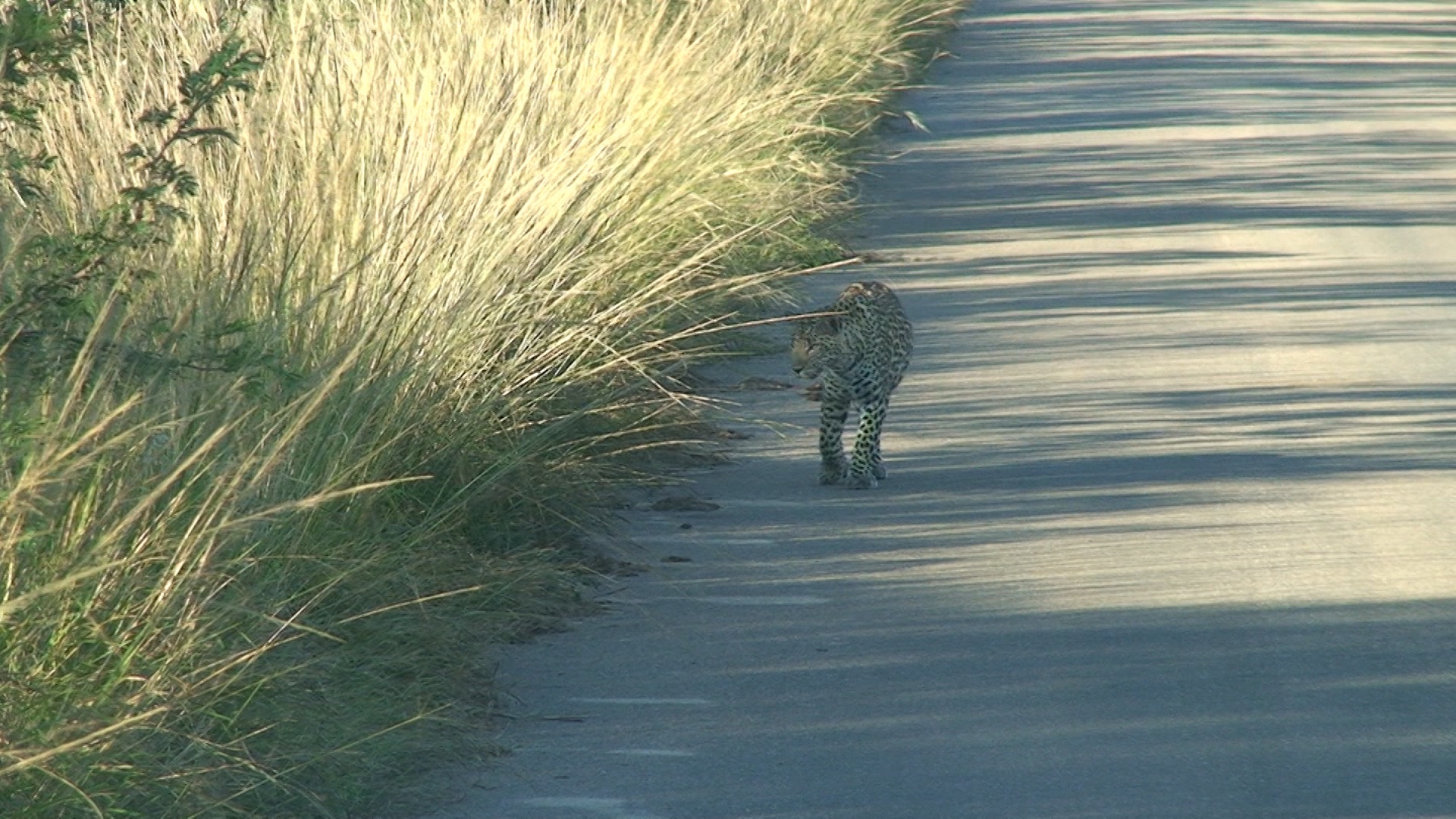
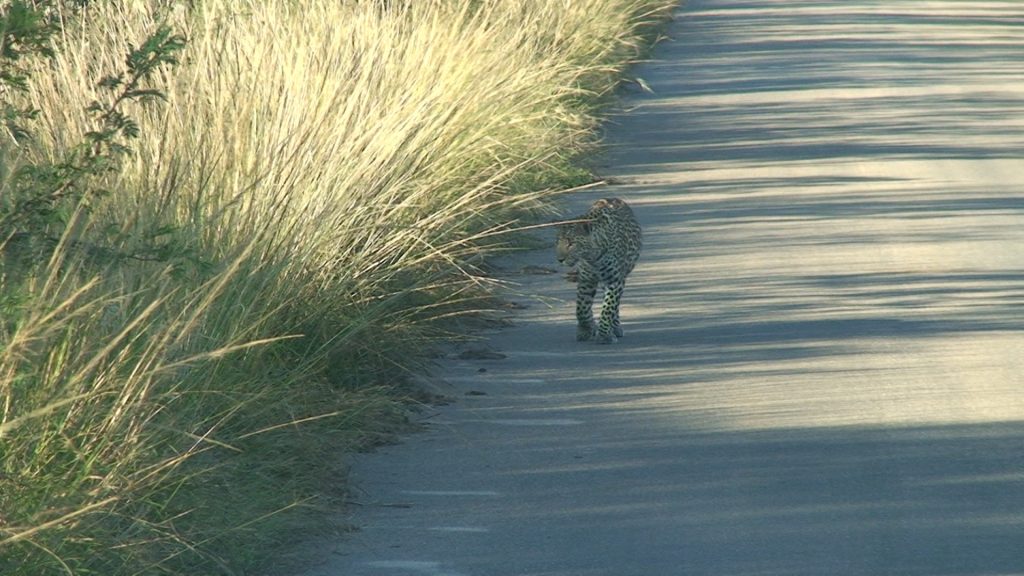
She turned her head again, looked in the direction of the lions, looked behind her, turned back, and then looked below the tree. The next moment she bound down out of the tree, moving quickly, low on the ground, through the grass, crossed the road and disappeared into the long grass on the other side in the blink of an eye.
Ten interesting facts about leopards:
- In general, leopards are solitary animals, only enjoying company in the mating season or when raising their cubs.
- They can reach an age of twelve to seventeen years.
- They are not as fast as cheetahs but can reach speeds of up to 58 km per hour.
- They can jump as far as six meters.
- They do not only eat meat, but will vary their diet with insects, fish and whatever else they can find.
- During daytime, they will usually be resting. At night, they explore and hunt.
- Two to three cubs are born at a time.
- Mothers will stay with their cubs for two years, thereafter, parting their ways.
- The spots on their bodies are called “rosettes”, as they are rose-shaped.
A mathematical formula was discovered to explain the pattern of their spots – the spots are not arranged randomly at all! Read more about this at https://www.bbcearth.com/news/the-maths-behind-a-leopards-spots
Share on

Latest articles