

Nature’s corner 81: A giant kingfisher, wood sandpiper and great egret hunting
By André Christof
Join André and Katie of Op vlerke once again in the Kruger National Park. André tells us more about the rich animal and bird life at a bridge across the Letaba River:
One year, on our way from Phalaborwa Gate to Mopani Rest Camp, we stop on the other side of the very steep sloping bank on the low-water bridge across the Letaba River.
The river is wide, the water flows from the west down the side, which then, quite some distance away, divides into a few streams to the left of the bridge, flows around huge sandbanks, after which it merges again to the right of the bridge and rushes on in the direction of Letaba Rest Camp.
Beyond the sandbanks, one can see low vegetation in the riverbank, tufts of yellow-brown grass and rows of tracks where animals had walked from the other side on the soft sand towards the water.
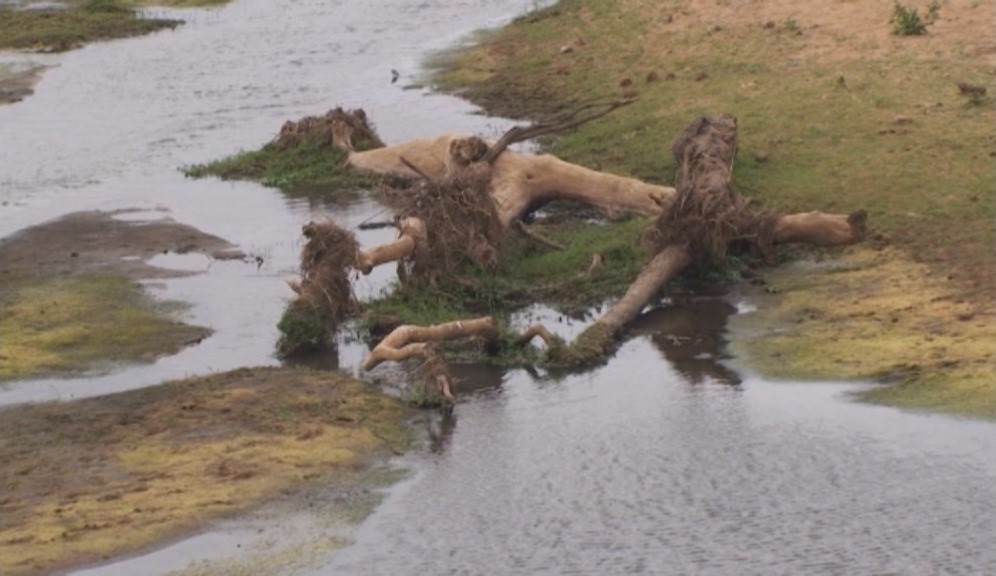
We spot a massive sycamore figtree with its yellowish trunk that had been swept away by floodwaters, lying there in the shallow water at the confluence. One sees its giant roots with large longitudinal ridges at its base and a few thick branches that have not yet decomposed, with driftwood caught in them.
The wind blows so strongly against the direction of the river’s currents that in places it seems as if the water is flowing upstream.
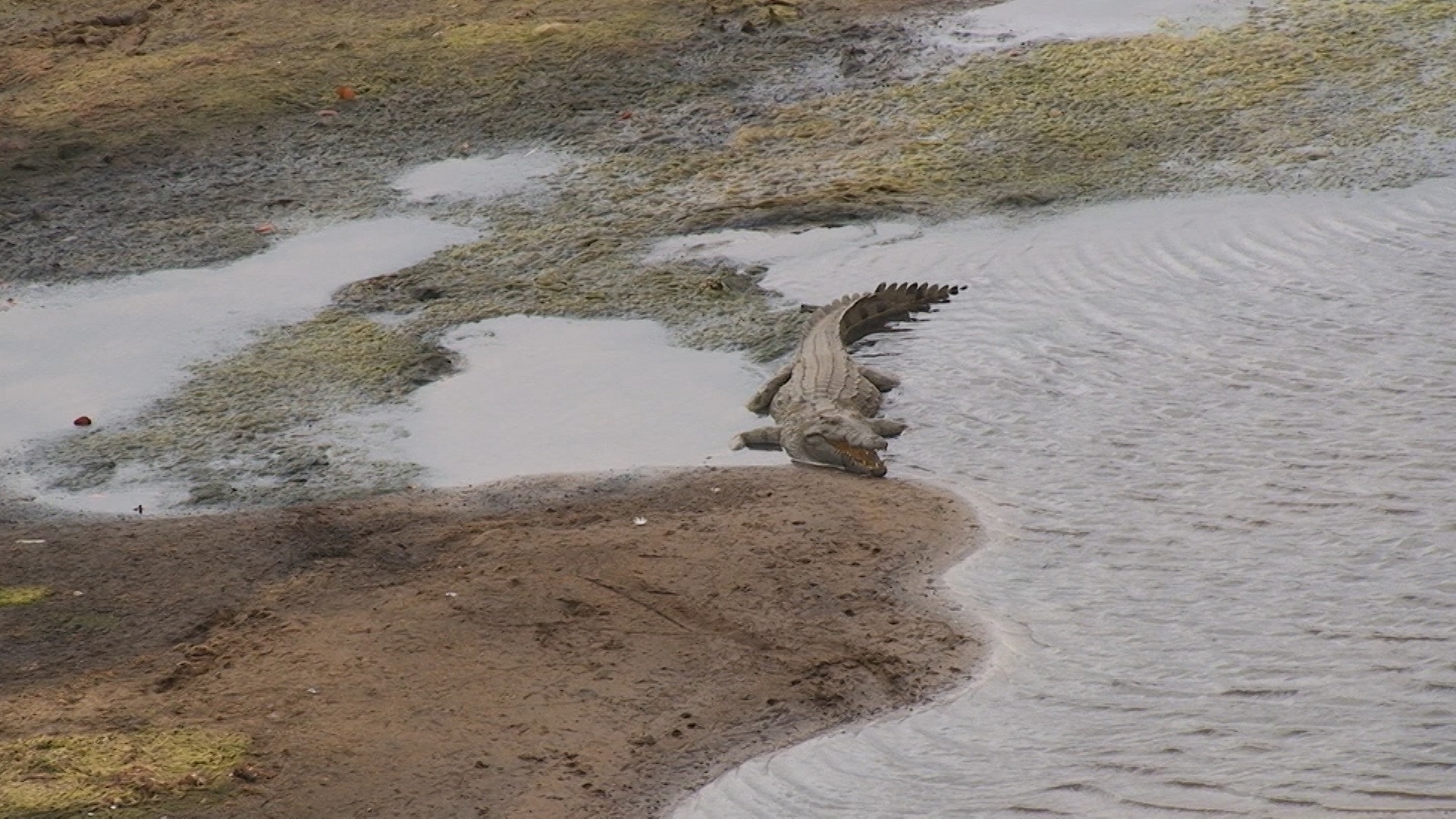
Not far from the sycamore fig, a crocodile is resting. We can see his characteristic long triangular snout, armour of horn-like scales all over his body and two rows of huge spines on top of its tail that merge into one row towards the tip. In a cove of a sandbank, in the tranquillity of the shallow water, he lies sheltered from the wind, staring across the water with his ginger eyes, his mouth wide open.
Next, we notice a giant kingfisher here close to us, diving into the water from below the bridge. It is unmistakable with its long, heavy beak, striking crest, dark back with white spots and reddish-brown chest. It sits on one of the bridge’s concrete pillars from where it watches the water flowing beneath the bridge, its feathers fluttering in the wind.
Now and then it dives into the river. We cannot see the water, it is too close to the shore. Once it returns to its perch with a fish, a large one.
It carefully manoeuvres the fish, turns it sideways in its beak and hits it against its perch. It swings its head back to one side, across its back, strikes forward with great speed, then whacks the fish against the pillar. It keeps on bashing the fish until it is soft, then it carefully moves until its head points towards his throat and begins to swallow the fish in instalments.
Upstream seven waterbuck cows are lying on a sandbank to the right of the stream. One is standing at the water’s edge, looking out across the riverbed. A ram lies some way to the right on a different sandbank, his back turned to the cows.
Closer to the bridge, five bulls are grazing in the short green grass along the left side of the stream, the one in front turns away, walks to where the water is flowing around some stones in a bend, right by a woolly-necked stork. The latter moves slowly, it is hunched, searching for some greenery that it has spotted on the side of a sandbank nearby.
Beyond the woolly-necked stork we spot a black crake – a small, jet-black bird with a rotund body, short tail, strong bright yellow beak and red legs.
Now and then we hear its noisy, bubbly weet-eet-eet-eet, weet-eet-eet-eet call, where the bird is searching for insects, crustaceans, seeds and other plant material.
A short distance from the black crake a wood sandpiper is looking for food with its tail bobbing so energetically that its whole body is swaying. It has a long, fine beak, a striking white eyebrow line, some streaking across its chest, a dark brown back with yellow spots and long yellow legs.
At one point it stops, peering down the side of the riverbank, then it moves, bobbing, towards the tranquillity of the shallow water where it crouches down between the rocks on the side, searching for pebbles and pecking at something every now and then.
It is a very noisy bird. We hear its high, slightly descending chirping call: iff iff.
Just beyond it a great egret is on the hunt. It has a slender black bill, black legs and feet, a long S-shaped neck and extravagant plumes on the back of its head. Its long neck is stretched out as it peers into the knee-deep water. Later it walks down a sandbar into the stream, turns right in front of a group of rocks, follows the stream, spots a catch some distance ahead, trots forward quickly, pecks, misses, and now it stands looking at the spot for a while.
Then it walks to a stream flowing down into the river on the other side of the rocks. The next moment it takes off, runs down into the fast-flowing water, takes long strides after its prey, its legs raised high, opens its wings, leaps forward, its legs slanting backwards above the surface, lands and flaps its right wing. He steers with this wing, swerves left, flaps the left wing, flies right, pecks, misses again.
Now he turns around completely, walks a little way downstream, turns around, then walks upstream, searches, turns around again, trots downstream, then stands peering into the water, turns around once more, walks upstream, flies back around again.
Later he walks up the fast-flowing strip of water, searching. Every now and then he stands still, shuffles his feet on the bottom, peers at the water, walks further upstream and finally disappears around a bend beyond a sandbank.
Share on

Latest articles