

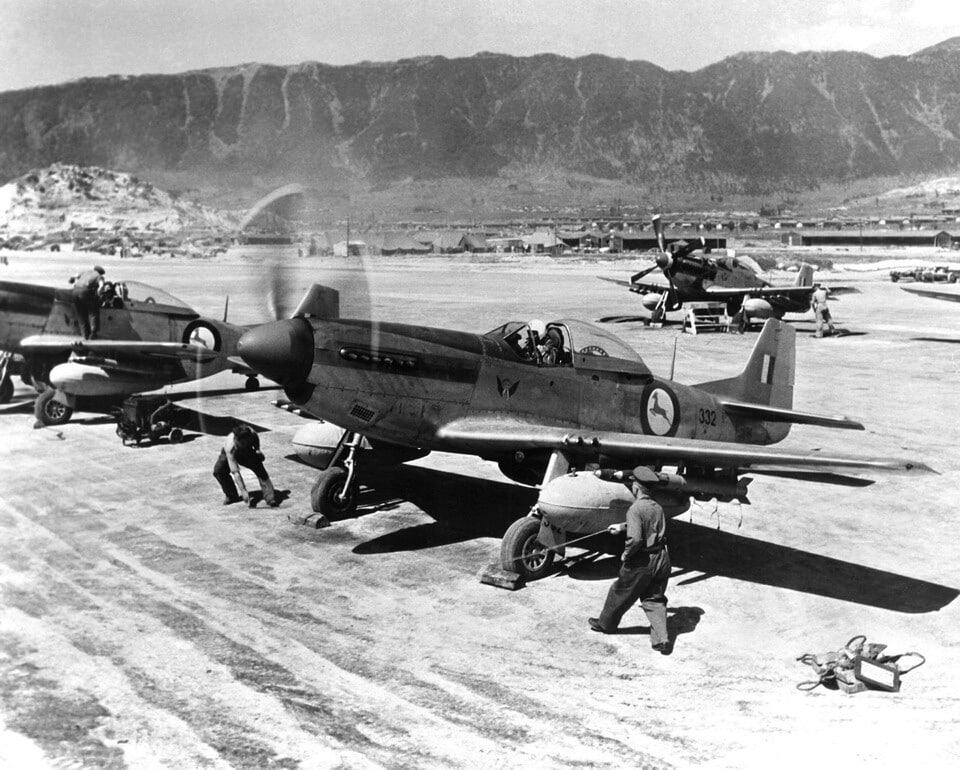
Currently many South Africans are employed as teachers in South Korea, but our ties with this country are much older. During the Korean War (1950-1953), members of the South African Air Force (SAAF) played a crucial part there.
The war was a struggle between the Soviet- and Chinese-backed communist North Korea and anti-communist South Korea, which was supported by the United States and the United Nations (UN). It started when North Korea invaded the south on 25 June 1950.
Calls of the UN’s Security Council for North Korea to cease all hostilities were ignored, and as a result, a resolution was passed that members of the UN had to help protect South Korea and restore peace in the region.
As a founding member of the UN, the South African government responded to the UN’s call for help by providing a fighter squadron of the SAAF with ground personnel. Participation in the war was voluntary – at that time the SAAF could not compel its members to become involved in military operations abroad.
On 26 September 1950, Number 2 Squadron, also known as the “Flying Cheetahs”, departed for Korea. The squadron was attached to the US Air Force’s 18th Fighter-Bomber Wing with its F-51D Mustangs and later F-86F Sabres. By the end of the war, the squadron had flown a total of 12 067 combat missions, losing 74 of its 97 Mustangs and 4 of its 22 Sabres. In total, 826 South Africans served during the war. They comprised 243 air force officers, 545 ground personnel and 38 army officers and men who were involved as part of the First Commonwealth Division. Officially, 37 of them died during the war.
The Facebook group “South Africans in WW1, WW2 and Korean War” is a treasure trove of information about the South Africans’ participation. According to Dirk Louw, one of the members of the group, the 37 fallen comprised 34 pilots and a non-commissioned officer. Furthermore, Warrant Officer R.H. Carpenter died in Mauritius en route to Korea. The 37th deceased was Lieutenant Mike Halley. He was shot down in Korea on 23 July 1951, after which he was held as a prisoner of war until hostilities ceased in July 1953. He passed away on 15 August 1954 at the age of 25 due to illnesses he contracted as a result of the terrible conditions in the prisoner of war camps.
Eleven of the deceased were buried in the UN Memorial Cemetery in Busan, Korea. In November 2024, Glen Devilliers posted photos of their graves and information about them on the aforementioned Facebook group. Not all died during combat. For example, Lieutenant T. Liebenberg died in an accident while taking off on 10 June 1951, which proves how dangerous the conditions were under which they operated.
The later Chief of the SAAF, Lieutenant General Denis John Earp, was also one of the pilots who served in the war. After his Mustang had been hit, he had to bail out and was captured. He was held as a prisoner of war for 23 months.
There was humour, too. There seemed to have been “friendly rivalry” between the South African and American pilots. The South Africans were apparently able to detect ground targets much faster than the Americans could – why is not clear. To ensure that they could then attack the targets first, they tried to withhold information from the Americans by speaking Afrikaans to each other. This tactic worked until the American commander ordered that all pilots had to speak English only.
In addition to the graves in Busan, there are also two beautiful memorials in South Korea that pay tribute to the South Africans. The names of the deceased also appear on the roll of honour available on the website of the Korea War Memorial Organization (www.warmemo.or.kr:8443).
The first memorial is the Korean War Memorial of the South African Air Force in Pyeongtaek, South Korea. It was unveiled on 29 September 1975 by the Ministry of Defence of the Republic of Korea. It includes a plaque with the names of 36 of the deceased. The memorial includes a beautiful statue of a standing springbok ram – the symbol internationally associated with South African military forces. The plaque on the monument contains the following words:
INSCRIPTION
THE HIGH IDEALS OF FREEDOM AND GOODWILL
AMONG NATIONS OF THESE SOUTH AFRICANS
ARE OUR PROUD LEGACY
THE HEAVY CASUALTIES SUFFERED
OUR ABIDING INSPIRATION
The second is part of the War Memorial Museum of Korea in Seoul. Columns acknowledge the countries that participated in the war, including South Africa. The South African flag flies above it.
The squadron has also been recognised with various awards, including the United States Presidential Citation, the Korean Presidential Citation, and the USAF Unit Citation.
In Washington D.C., a memorial pays tribute to American veterans of the Korean War and on the UN Wall that is part of it, recognition is also given to the South Africans role in the war.
In South Africa, there are several war memorials that include tributes to the veterans of this war, such as the SAAF Monument on Bays Hill at the Swartkop Air Force Base, at the Union Buildings and as part of the Cenotaph in Cape Town.
In the shadow of so many other wars of the twentieth century that preceded and followed it, the Korean War has almost faded into oblivion, but the unique role of the intrepid South Africans who were involved in it, deserves be remembered.
Share on