

Nature’s corner 82: Mopani Rest Camp, a thick-tailed greater galago and a small lion
By André Christof
Let’s join André and Katie once again in the Kruger National Park. This time we are visiting Mopani Rest Camp.
This camp is located on the banks of Pioneer Dam. All the buildings in the camp are built of natural materials, including local stone to blend in with the rocky landscape and the foothills along which it is located.
On our way north one year we decide to make a quick stop there.
From a distance we admire the entrance gate made of stone under a thatched roof, with the gatehouse on the left and the name “Mopani” engraved on the wall in a huge board made of durable mopani wood with its rich colour and unique grain. The letters are mustard-coloured and italic, the capital letter M is comprised of two compound mopani leaves on a single stem, the leaves light green.
On the other side of the gate, we drive past aloes under trees that line both sides of the road. We also see some under trees at the reception area and to the right past the petrol station where you turn off to the picnic area for day visitors.
The birds are having a great time.
Chee-chee-chee-chee-trrr, chee-chee-chee-chee-trrr, one calls.
Trrr-chree-tjrrrr, trrr-chree-tjrrrr, trrr-chree-tjrrrr, a red‑shouldered glossy starling responds.
But now three grey louries catch our attention. Two of them are sitting on a branch in a tree a short distance from the petrol station. Now and then they give their typical harsh, nasal “go away” calls. They have an almost uniform ash-grey plumage with long tails and sparse, long, backward-curved crests that can be lifted almost vertically. Their strongly curved bills are black and their plumage is dark grey around their chins and throats, pale grey around the eyes and on their bellies, with their breast plumage slightly tinged with olive.
The third one is busy on a patch of grass at the base of a tree, under the spray of a sprinkler in a small pool of water that has formed there. First he lowers his breast, then he flaps his wings, with water splashing everywhere. In between he puffs up his feathers, every now and then he straightens up, then he lowers his breast again, sometimes he spreads a wing wide open above his back. He leans over to the other side, after a while he closes the wing, flaps both wings, then it is the turn of the other wing. Later, he opens his wings on both sides with his breast low on the ground. After a while, he shakes his body and then flies back to the tree where he sits on a branch, combing his feathers.
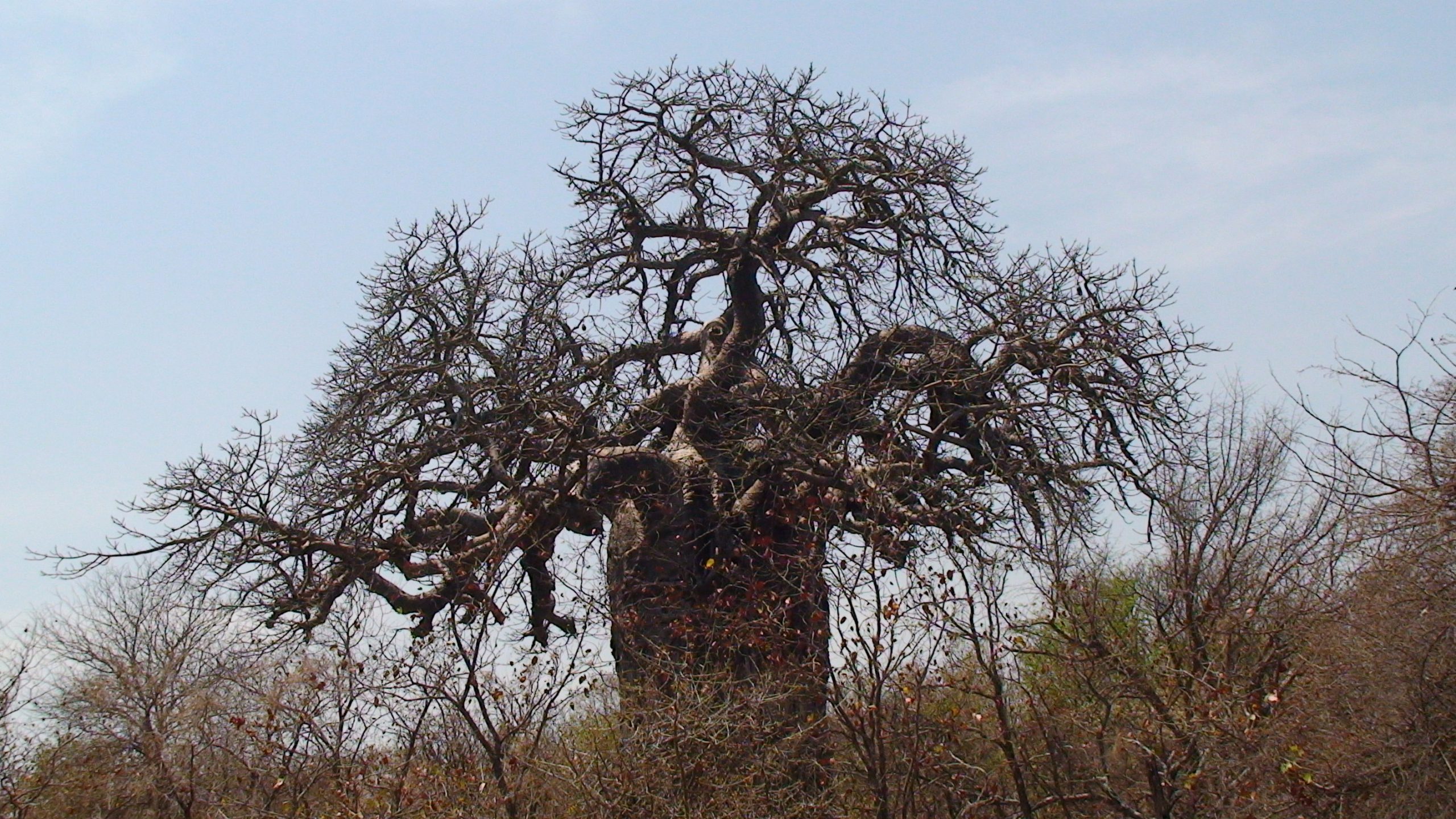
The camp also has a variety of other tree species. We stop at the picnic area with braai facilities for day visitors, walk down a slope and admire the well-known large, gnarled old baobab tree with its round flattened crown standing in the heart of the camp. Owl nests can be seen high up in its massive trunk.
A little further on we stop in the parking area in front of the thatched restaurant and shopping complex. It overlooks Pioneer Dam. We first go and have a look at the souvenirs. The stuffed toy animals in particular attract attention, as always when we are there.
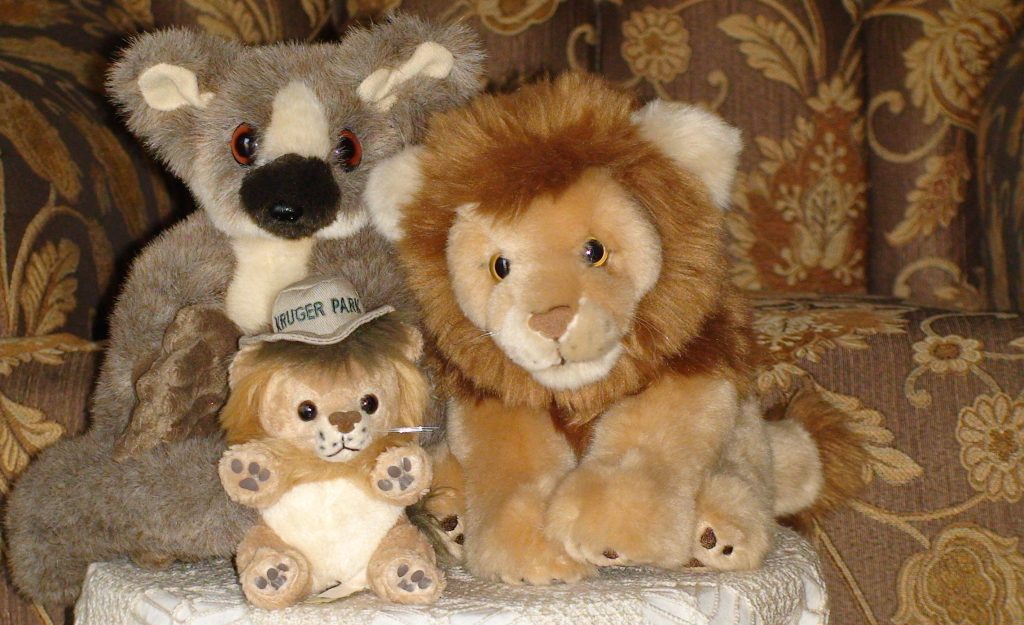
At home we have a toy lion with a wild mane of dark brown hair and yellowish eyes that Kate once bought there, as well as a thick-tailed greater galago that is slightly larger. The latter has a long, thick tail that you can wrap around its body like a blanket, and big round eyes. In nature, this galago is the one that makes loud haaah, haaah, haaah, haaah, haaah sounds at night. We also have a small toy lion, with a dark brown tuft at the end of its tail, which actually is a key holder, to complete the trio. I also have a similar one as a key holder for my car.
Later in the day we move through the exit to a wooden deck where people sit at tables and have something to eat from the cafeteria. We walk to the left of it across a platform between stone pillars under a thatched roof to the viewpoint that looks out across the dam some distance from the camp fence.
On the way there we study a rocky patch with natural vegetation that runs diagonally down the slope below the platform – the mopanes grow like shrubs here. To the right of it, at the bottom of the wooden deck, there are some boulders, a bench for two and steps that lead up to it from the cafeteria’s side.
We notice a plated lizard lying on warm-coloured stones, basking in the sun. The lizard has a relatively small, flattened head and flat body. Its legs are short and its back is dark brown to black. Its scales are plate-like with yellow dots which create a speckled transverse pattern. Its throat is off-white and its belly light brown.
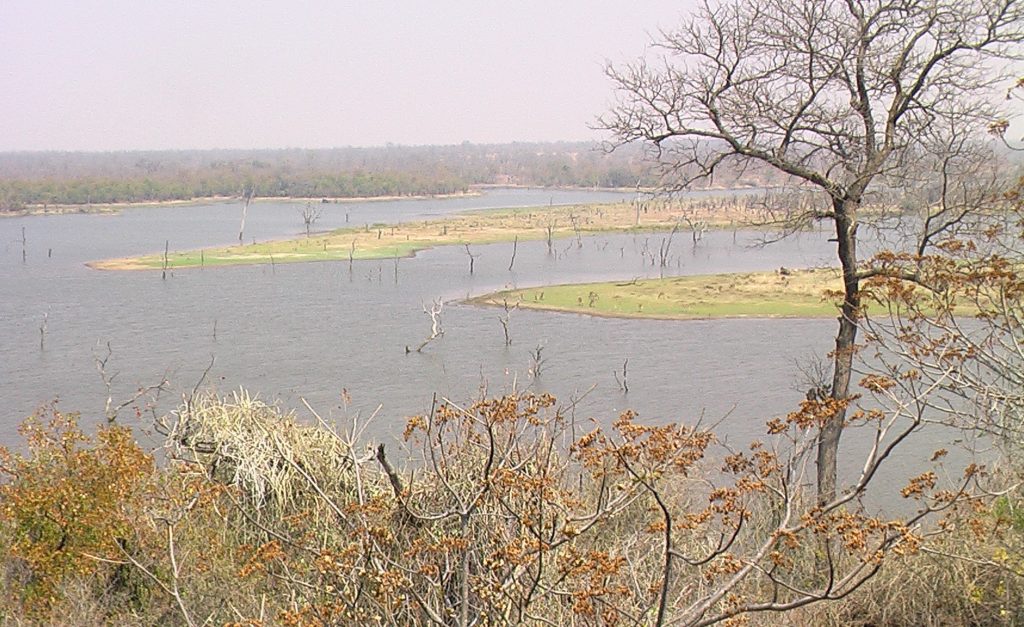
At the viewpoint we look out across the vegetation. It’s just water as far as the eye can see, all the way to the left around the corner, mirror-smooth, with coves etched against a sea of autumn-coloured mopane in the background.
Trrrrrrr, trrrrrrr, trrrrrrr, a crested barbet calls in the mopane to our left. It is a male calling loudly and quaveringly. This colourful bird has a thick pale-yellow bill with a dark tip. Its brightly coloured feathers and small, bushy black crest are unmistakable.
We decide to take a detour to the other side of the camp before we set off again. We walk back to the wooden deck, once again passing the people sitting at the tables and enjoying refreshments from the cafeteria.
A little further on we walk to the left of the restaurant overlooking the dam, follow a wooden footpath sloping down to where a ladies’ bar is situated in front of huge round-backed boulders on a level below the restaurant, and watch a herd of waterbuck walking along the water towards us on the opposite side.
Share on

Latest articles